- Home
- Applications
- Floors
Floors
One advanced microcement floor, room to room, no tiles, no grout, no joins. It’s only a millimetre or two thick, so it goes over concrete, tile or screed and your floor heights and door thresholds barely move. Floors take Xtreme: the coarser grades have more body, which is what you walk on, and the sealer takes the wear.
The floor underneath does the work.
Microcement can’t level a floor or fill a hollow. It follows what’s under it, so a slab that’s out of level stays out of level. Levelling is a separate job, done first with a self-leveller.
New concrete or screed has to be fully cured and dry; most manufacturers say about four weeks and a moisture check. And if there’s a movement joint through the area, it gets carried through the finish, not covered. A couple of millimetres of coating won’t hold a slab still, and a buried joint comes back as a crack.
Underfloor heating? Can be done. The heating has to go through its full commissioning cycle first and be off during the application. Tell us and we’ll walk you through the timing.
Not sure what your floor is, or whether it’s dry enough? Send us a photo.

Tiled? The tiles stay.
Tap them and relay anything hollow. Key the glaze and fill every grout line flush with the acrylic render base, because on a floor the grout lines are exactly where a coating cracks first. Tell us you’re going over a tiled floor and we’ll say whether it wants mesh too.
Tell us you’re going over tiles and we’ll include the base.
Which kit, which grade.
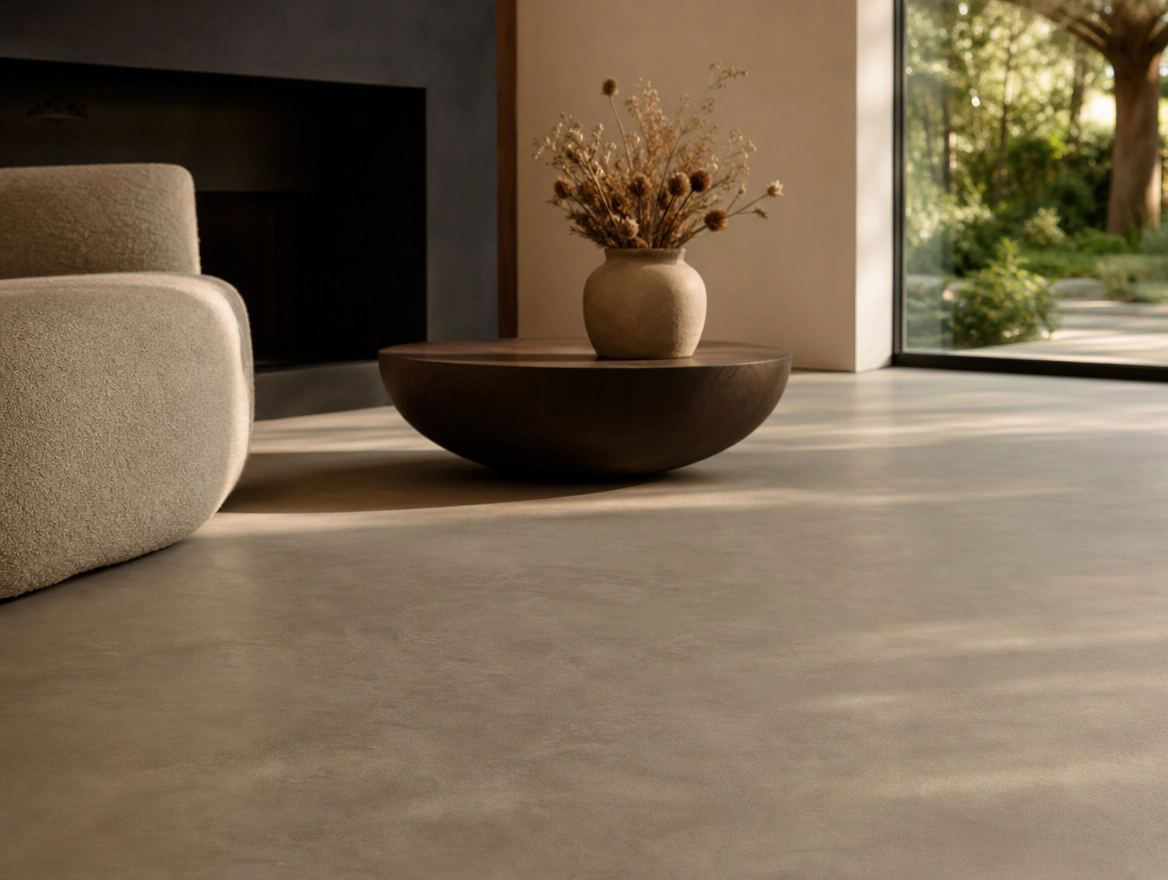
Pick Floor in the builder, then Dry for a living room or hallway, Wet for a bathroom or laundry. Wet adds mesh.
The grade is the real decision. Medium is the usual pick for an indoor floor: enough body to wear well, easy on the eye. Coarse has more grain, looks like stone or raw concrete, and gives more grip, which is what you want where it gets wet. Fine is for walls.
Tell us the room and we’ll point you at a grade.
The sealer is what you walk on.
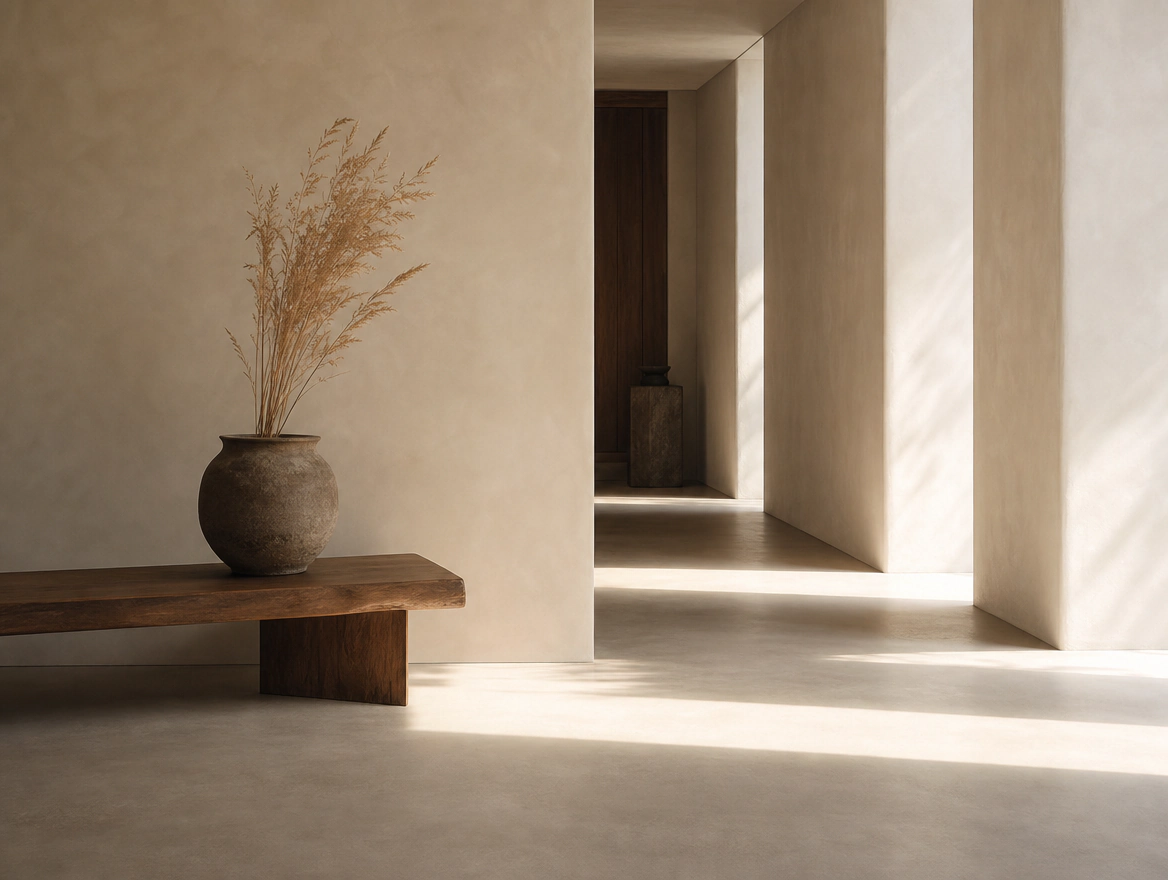
On a floor the sealer takes the feet, the chair legs and the dropped keys, not the cement under it. Sealers cure over days, not hours: light foot traffic first, then furniture, then a mop. Ask us for the timing on your kit and plan the move-in around it.
Clean with a pH-neutral cleaner and a soft mop, nothing abrasive. Reseal every few years depending on how hard it’s used. It’s a weekend job, not a rebuild.
Need a slip rating, on stairs or in a commercial space? That comes from a test on the finished floor with its sealer, not from the material. Tell us the job and we’ll say what’s involved.
Four things people ask about this room.
01 Does microcement crack?
Not on its own. It’s a thin, flexible mineral coating, and on a sound surface it stays in one piece.
What it can’t do is hold together something moving underneath it. A couple of millimetres of coating won’t restrain a slab, so if the surface cracks or a movement joint runs through the area, that comes through. Movement joints get carried through the coating, not covered, and wet-area kits add mesh to stop joints and grout lines showing.
Cracks in a finished floor nearly always trace back to what’s underneath. Tell us what you’re covering and we’ll tell you what it needs.
Entry 04 in the FAQ02 What does a kit cost and cover?
One tub does 15 m2. Kits come in 15 m2 (one tub) and 30 m2 (two tubs). Kits from $399 for a 15 m2 wall kit. Floors, wet areas and going over tiles change the price, so call us or send the job and we’ll price it. Wet-area kits add mesh. Over 30 m2 is a supply job and we quote it.
A kit price is the material, not an installed job. If you’re pricing an applicator, their quote covers labour and prep as well, and it’s a different number.
Entry 06 in the FAQ03 Which kit, X-Micro or Xtreme?
Go by what you’re covering, not what you want to spend. X-Micro is the wall kit: one super-fine grade for a smooth finish, and in a bathroom it’s the finish over your waterproofing. Xtreme does walls and floors, in coarse, medium and fine, and it’s harder wearing.
Walls only? X-Micro will do it. You don’t need Xtreme’s hardness on a surface nobody walks on. Any floor in the job? Xtreme.
Entry 07 in the FAQ04 Microcement vs polished concrete
Polished concrete is the slab itself, ground back and sealed. Microcement is a coating that goes over an existing surface, so it doesn’t need a slab to start with. It goes over tile, render or an existing floor.
Entry 15 in the FAQGo straight to the kit.
These are supply kits: primer, advanced microcement, sealer and the hand tools. You do the work. What a kit costs and covers.