
X-MicroFor walls, and bathroom walls over your waterproofing.
X-Micro
For walls, and bathroom walls over your waterproofing.
Kits from $399 for a 15 m2 wall kit
View kitThe questions we get most, with straight answers. It’s all on the page, nothing to click open.
A skin, not a slab. Microcement (micro cement, microtopping, same thing) is a thin cement-based coating you trowel on by hand in a few passes. The whole system ends up about as thick as a couple of coats of paint, and it sets as one surface with no grout and no joins.
Because it’s that thin it goes over what’s already there: tile, render, or a wall that’s never been finished. It also means whatever’s underneath does the structural work. A kit goes on in layers: primer, advanced microcement, sealer.
No. Be wary of anyone who says it is. Microcement is water-resistant. Sealed properly it shrugs off everyday water and splashes.
What keeps water out of the building is the waterproofing membrane underneath, and in Australia that has to comply on its own. Microcement is the finish over the top. Wet area already waterproofed and signed off? You’re ready for a kit. Not done? Talk to your waterproofer first.
Yes. Most reno jobs do. The tiles have to be sound (tap them, relay anything hollow), the glaze gets keyed so the primer grips, and every grout line gets filled flush with the acrylic render base and left to harden. Skip the filling and the grout pattern comes through.
Tell us you’re going over tiles and we’ll include the base in the price.
Not on its own. It’s a thin, flexible mineral coating, and on a sound surface it stays in one piece.
What it can’t do is hold together something moving underneath it. A couple of millimetres of coating won’t restrain a slab, so if the surface cracks or a movement joint runs through the area, that comes through. Movement joints get carried through the coating, not covered, and wet-area kits add mesh to stop joints and grout lines showing.
Cracks in a finished floor nearly always trace back to what’s underneath. Tell us what you’re covering and we’ll tell you what it needs.

No. Bunnings doesn’t stock microcement kits. One product, Dulux Creativo, can be special-ordered through some stores. We sell advanced microcement direct. Call us or send an enquiry and we’ll help you pick the right kit.
Rather collect than wait for a courier? Pickup from Erina is free.
See the two kitsOne tub does 15 m2. Kits come in 15 m2 (one tub) and 30 m2 (two tubs). Kits from $399 for a 15 m2 wall kit. Floors, wet areas and going over tiles change the price, so call us or send the job and we’ll price it. Wet-area kits add mesh. Over 30 m2 is a supply job and we quote it.
A kit price is the material, not an installed job. If you’re pricing an applicator, their quote covers labour and prep as well, and it’s a different number.
Ask us the priceGo by what you’re covering, not what you want to spend. X-Micro is the wall kit: one super-fine grade for a smooth finish, and in a bathroom it’s the finish over your waterproofing. Xtreme does walls and floors, in coarse, medium and fine, and it’s harder wearing.
Walls only? X-Micro will do it. You don’t need Xtreme’s hardness on a surface nobody walks on. Any floor in the job? Xtreme.
Compare the two kitsYes. Most of our kits go to people doing one room themselves. No training needed; it’s all premixed. It’s trowelling, not tiling, and it’s forgiving because you sand between coats, so a pass that isn’t perfect gets fixed before the next one.
What catches people out isn’t the trowelling, it’s the prep. The surface has to be sound, clean and primed with the right primer for what you’re covering, because tile and plasterboard drink very differently. Get that right and the rest is patience and thin passes.
Read the steps before you start. Anything unclear about your surface, send us a photo. Don’t want to do it yourself? We’ve got applicators.
How it goes onA home job is a 15 or 30 m2 kit. Pick the kit, then call us or send the job and we price it.
More than two kits, trade pricing or repeat supply is a business enquiry. Send us the job or call, and we’ll quote it.
Send us the jobEvery kit has primer, advanced microcement, sealer, PVC trowel, stainless steel trowel, wet-and-dry sandpaper roll, scoop, PVC flat blade. Wet-area kits add mesh, and a tiled surface adds the acrylic render base.
You’ll also need a mixing drill, to stir the tub back to an even mix, and a drop sheet. Neither is in the kit.
Not from a kit. A benchtop takes a different build-up and a harder sealer than a wall, because it cops heat, knives and citrus every day. Tell us the benchtop and we’ll quote it.
Send us the benchtopFree pickup from the studio in Erina. We’ll confirm a time when you order. Courier is quoted by postcode. Tell us where you are. More than two kits? Send us the job and we’ll quote it.
Venetian plaster is a decorative lime finish for walls, loved for its polished depth. Microcement is a harder-wearing cement-based coating that also works on floors and in wet areas. If the surface gets walked on, splashed or scrubbed, microcement. For a purely decorative wall, both work; it comes down to the look.
Tiles bring grout, and grout brings cleaning, cracking and dated lines. Advanced microcement is one surface a millimetre or two thick with nothing to catch grime, and it usually goes straight over the tiles you’ve got. No demolition, no skip, and a bathroom that reads as one piece.
What tiles have over it: a cracked tile is one tile. A crack in microcement traces back to what’s underneath, which is why the prep matters so much.
Polished concrete is the slab itself, ground back and sealed. Microcement is a coating that goes over an existing surface, so it doesn’t need a slab to start with. It goes over tile, render or an existing floor.
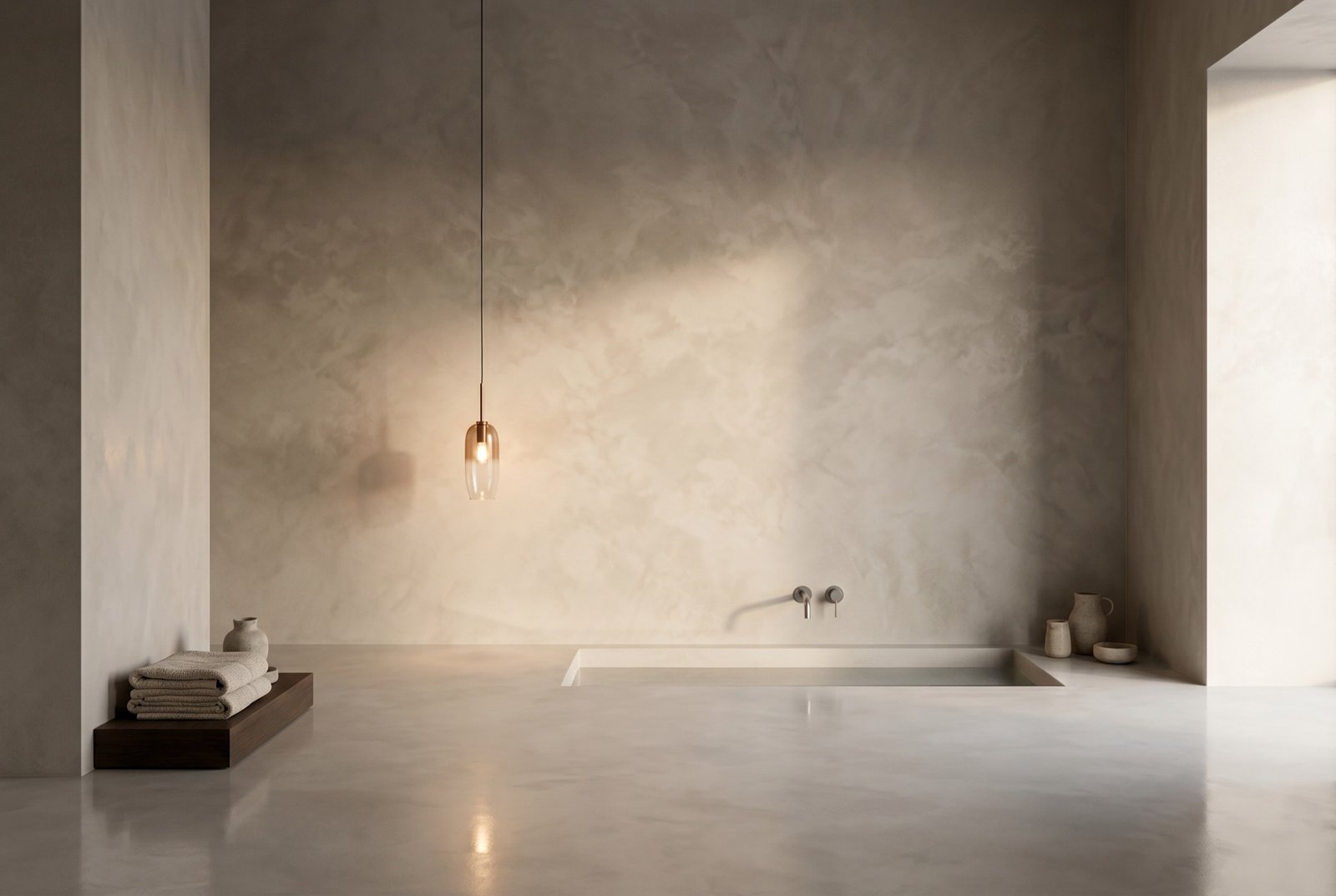
A pH-neutral cleaner and a soft cloth or mop, spills wiped up promptly, nothing abrasive, no bleach. You’re looking after the sealer, not the cement.
Reseal every few years on a floor, sooner in a daily shower, much less often on a wall. It’s a weekend job you can do yourself. Ask us when you’re due and we’ll tell you what to use.
Sealed, yes, for everyday use. The sealer takes the wear, and a cured sealer shrugs off water, oil and soap. Acids and alcohol are the ones to wipe up: vinegar, lemon juice and spirits work on the sealer if they sit.
It isn’t scratch-proof. A dragged chair or a dropped knife can mark it, so felt under the chair legs.
As long as the surface underneath and the sealer on top. The cement doesn’t wear out; the sealer does, slowly, and you renew it. A floor over a sound slab, resealed when it’s due, is a long-term finish.
A floor over a cracking slab is a cracking floor with a finish on it. That’s why we ask what you’re covering before we sell you a kit.
Walls, floors and wet areas: bathrooms, kitchens, feature walls. Outdoor is quoted per job. There’s no off-the-shelf outdoor kit, so tell us the job and we’ll price it.
See where microcement goes